 KeyProcess Automation Services
Blog · Costs and payback
Does business automation qualify for the R&D tax credit? A plain-English guide
What the federal R&D tax credit is, when custom automation work can count, who gets to claim it, and the records that make a claim hold up.
The short answer: sometimes. Custom automation work can qualify for the federal R&D tax credit when your business was unsure at the start how to build it, and the solution came from testing different approaches. Routine setups usually don't qualify. Whether a specific project counts is a call for your CPA.
Key takeaways
- The R&D credit reduces your federal tax bill, dollar for dollar, for paying people to solve technical problems you didn't already know how to solve.
- A project has to pass all four parts of the IRS test, and software for your own back office faces a higher bar on top of that.
- Tools your customers, tenants, or vendors use directly are held to the normal test, not the higher one.
- If you pay an outside firm, you can usually count 65% of what you paid for the qualifying work, as long as you carry the risk and keep the rights.
- Good records written during the project are what make a claim hold up.
Where this information comes from. This guide is based on information from Lawron Ballard, CPA, Principal at Hill Town Advisors, along with the IRS sources linked throughout. KeyProcess Automation Services may refer clients to, and receive referrals from, Hill Town Advisors.
Not tax advice. KeyProcess Automation Services builds and manages automations. We don't provide tax, legal, or accounting advice. This guide explains how the credit generally works so you can have a better conversation with your own CPA or tax advisor.
What is the R&D tax credit?
The federal research credit, found in Section 41 of the Internal Revenue Code, takes money off your tax bill, dollar for dollar, when your business pays people to solve technical problems it didn't already know how to solve. It isn't only for labs and tech companies. You don't need a patent or a breakthrough, and the project doesn't even have to work. The credit rewards the work of figuring it out.
Businesses claim it on IRS Form 6765. The IRS has been asking for more detail on that form. Under its December 2025 instructions, for tax years beginning after 2025, many businesses must describe each project separately, though smaller claims made on an original return are exempt. Either way, good records matter more than ever.
What is the four-part test for the R&D credit?
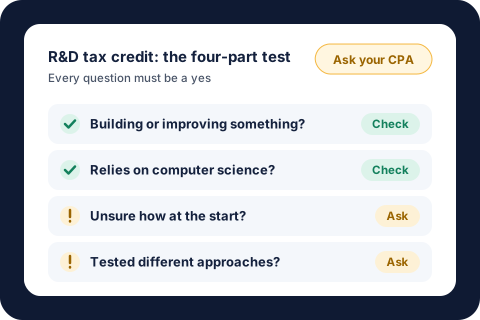
A project qualifies only if the answer to all four of these questions is yes. This is our plain-English version of the test in Section 41(d) and the Form 6765 instructions:
- Are we building or improving something? A product, a process, or a piece of software that works better, faster, or more reliably.
- Does it rely on hard science or computer science? Software and data work count. A new marketing slogan doesn't.
- At the start, were we unsure how to build it, or whether it would work? If the answer was obvious from day one, it doesn't count.
- Did we test and compare different approaches to get there? Trying one method, measuring it, and trying another is exactly what the credit rewards.
The test applies to each project on its own, so one project can qualify while another built the same year doesn't.
Does business automation qualify for the R&D credit?
Some of it can, but most everyday automation won't, and it's better to know that up front.
The higher bar for back-office software
Software a company builds for its own back-office work, like finance, HR, reporting, or data processing, is called internal-use software. Under the IRS rules, it must also pass a "high threshold of innovation" test: it has to be truly innovative, involve real financial risk, and do something you couldn't simply buy off the shelf. A routine setup, like sending form entries to a spreadsheet or emailing a weekly reminder, won't qualify, however much time it saves.
Where automation is more likely to qualify
- Tools your customers, tenants, or vendors use directly. Software that lets outside people start a task or look up their own information, like a portal or automated status updates, isn't treated as back-office software, so the higher bar doesn't apply.
- Hard technical problems. Pulling reliable data out of messy documents, connecting systems that have no clean way to talk to each other, or building custom logic that had to be tested and tuned until it worked.
- Long builds with real trial and error. In our experience, the projects worth asking a CPA about are the ones that took weeks of problem-solving, not the ones that took an afternoon.
Our honest take: if a project was mostly connecting tools in a known way, assume it doesn't qualify. If you remember thinking "we're not sure this is even possible" and trying several approaches, it's worth the conversation.
What costs count toward the R&D credit?
Three kinds of spending count as qualified research expenses, according to the Form 6765 instructions:
- Wages for the people doing, directly supervising, or directly supporting the technical work, for the share of their time spent on it.
- Supplies used up during the work.
- 65% of what you pay outside contractors to do qualifying research for you.
Routine upkeep, fixes after a tool is finished, and simply copying an existing process into a new system generally don't count.
Who claims the credit, you or the automation firm you hire?
Usually one or the other, not both. The credit isn't allowed for research that someone else pays for, so the contract decides who can claim it. In general, the business that carries the financial risk of the work and keeps the rights to what's built is the one that can claim it.
When you hire an automation firm and own what it builds for you, you're typically the one who can count 65% of what you paid for the qualifying work. Before you sign, ask your CPA to look at the contract's payment and ownership terms. With us, your business owns its accounts, data, and the work you pay for.
How much is the R&D tax credit worth?
Many small businesses use the simplified method in Section 41(c)(4). A business with no qualifying costs in any of the three prior years gets 6% of this year's qualifying costs. A business with a history of research spending gets 14% of the costs above half its three-year average. Many businesses also elect a slightly reduced credit, which the Form 6765 instructions set at 79% of the simplified credit, to keep their deduction simple.
An example, with made-up numbers. Say your company has never claimed the credit, and it pays $20,000 to an outside firm for a customer-facing tool that qualifies. 65% of that, $13,000, counts as qualifying cost. At 6%, the credit is about $780, or about $616 with the reduced election. It's real money, but it's a bonus, not a reason to start a project. A good automation should pay for itself in saved time first, which you can estimate with our savings calculator.
Small and young businesses can use it against payroll taxes
A business with under $5 million in gross receipts and no more than five years of receipts can elect to apply up to $500,000 a year of the credit against its payroll taxes, according to the IRS. That means the credit can help even before the business is profitable.
The deduction changed in 2025
For a few years, businesses had to spread their research costs over five years for tax purposes. A 2025 tax law added Section 174A, which lets businesses deduct U.S. research costs right away again, as the Form 6765 instructions describe. How that interacts with the credit, and whether earlier years can be revisited, is a question for your CPA.
What records do you need for an R&D credit claim?
Records written while the work happens hold up far better than memories pieced together a year later. For every project you might claim, keep:
- The problem. What you were trying to build, and what you didn't know how to do at the start.
- The approaches. Each method you tried, why, and what happened.
- The tests. Results, failures, and what changed between versions, with dates.
- The people and hours. Who worked on it and roughly how much of their time went to the technical work.
- The contract and invoices. What you paid an outside firm, and who owns the result.
On larger builds, we can give your CPA written project notes covering the problem, the approaches tried, the test results, and the hours spent. That way, if a project might qualify, your advisor has what they need. A free audit is a good place to start if you're weighing a bigger project. You can also see the kinds of work we do on our results page, and what it costs in our automation pricing guide.
About the author. Tyler founded KeyProcess Automation Services and has built dozens of automations, small and large, for property management and e-commerce teams. You can see what they changed on our results page.
FAQ
Common questions about the R&D tax credit and automation
Can automation software qualify for the R&D tax credit?
Sometimes. Custom automation work can qualify when the business was unsure at the start how to make it work and tested different approaches to solve it. Routine setups, like connecting a form to a spreadsheet, usually don't qualify. Your CPA decides for each project.
Who claims the R&D credit when I hire an outside firm?
Usually only one party can claim the credit for a project. When you pay for the work and keep the rights to what's built, you're typically the one who can claim it, counting 65% of what you paid for the qualifying work. The contract decides who carries the risk and who keeps the rights, so have your CPA review it.
How much is the R&D tax credit worth?
It depends on your qualifying costs. Under the simplified method, a business with no qualifying costs in any of the prior three years gets 6% of this year's qualifying costs. Businesses with a history of research spending can get 14% of the costs above half their three-year average. Your CPA will run the numbers.
Can a small business that isn't profitable use the R&D credit?
Possibly. A business with under $5 million in gross receipts and no more than five years of receipts can elect to use up to $500,000 a year of the credit against its payroll taxes, so the credit can help even before the business owes income tax.
Does the project have to succeed to qualify?
No. The credit rewards the work of solving a technical problem, not the result. What matters is that you were unsure how to do it at the start and tested different approaches, and that you kept records of that work.
Does KeyProcess Automation Services provide tax advice?
No. We build and manage automations. Whether a project qualifies depends on the work and your tax situation, so talk to your own CPA or tax advisor. We can give them written project notes that show the problem, the approaches tried, and the hours spent.
Planning a bigger automation project?
Book a free 30-minute audit. We'll look at your processes with you, and you'll leave with a written list of what to automate first and what it could save you, whether you hire us or not.
Request your free auditOr email tyler@keyprocessautomation.com