 KeyProcess Automation Services
New: the AI Workforce
A team of AI employees for every department
Every business has more work than people. We build each of your departments its own staff of AI employees. Each one has a desk, a job description, a task list, the tools it needs, and a scorecard that shows what it delivered and what it cost. Nothing goes out to customers, and no money is spent, without a yes from you.
- See what's really going on in your business, with every desk reporting what it found and what it's worth.
- Get more done without more hires, because work runs in parallel instead of waiting on you.
- Add to the bottom line with every desk's return shown for each $1 it costs.
Founding offer: the first 5 clients get 25% off setup for sharing their results. See pricing
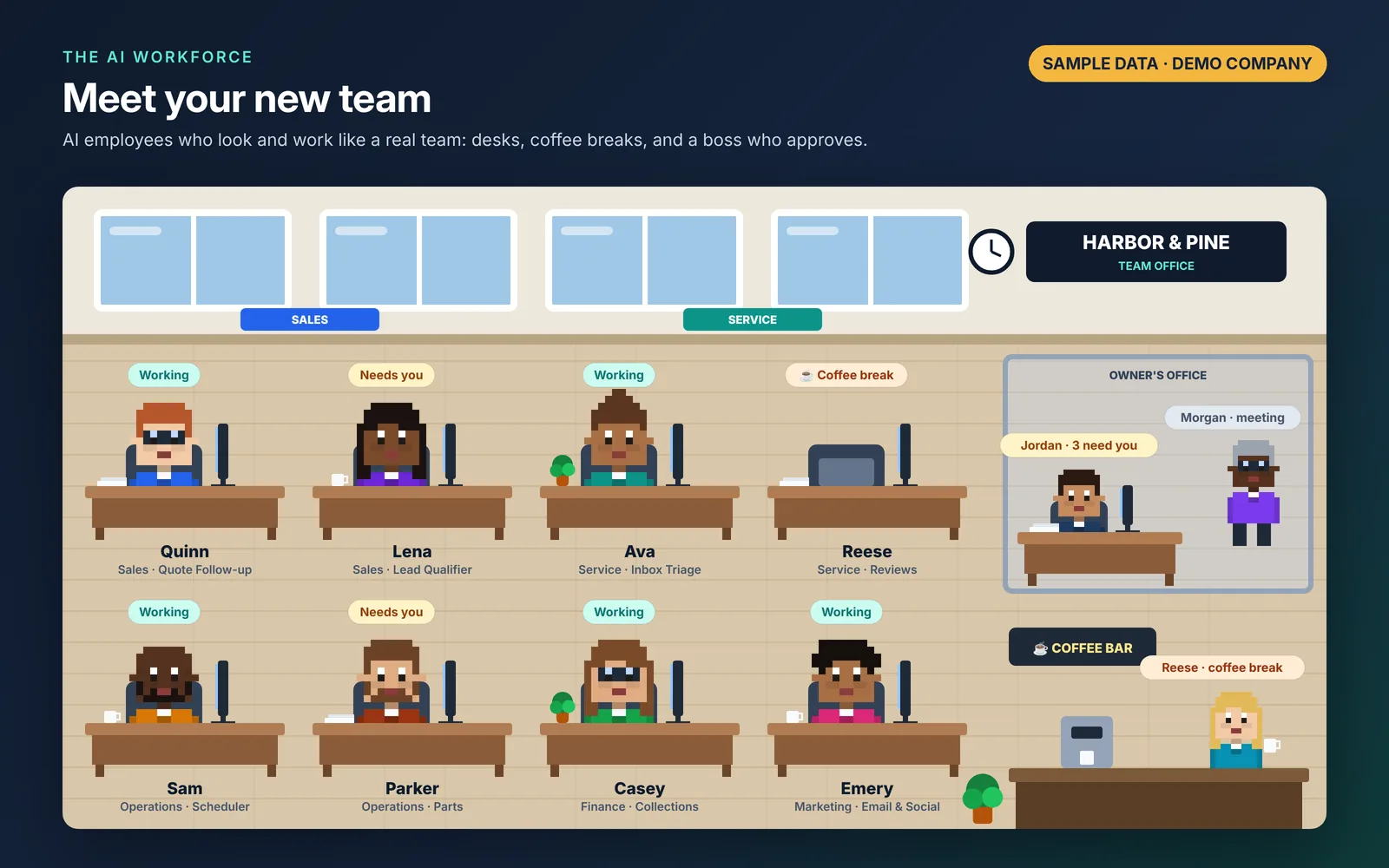
What it is
A virtual office for your business, on one page
Open it in a browser or on your phone. You manage AI employees the way you manage people: give them work, check what they made, and judge them by what they deliver.
A desk for every job
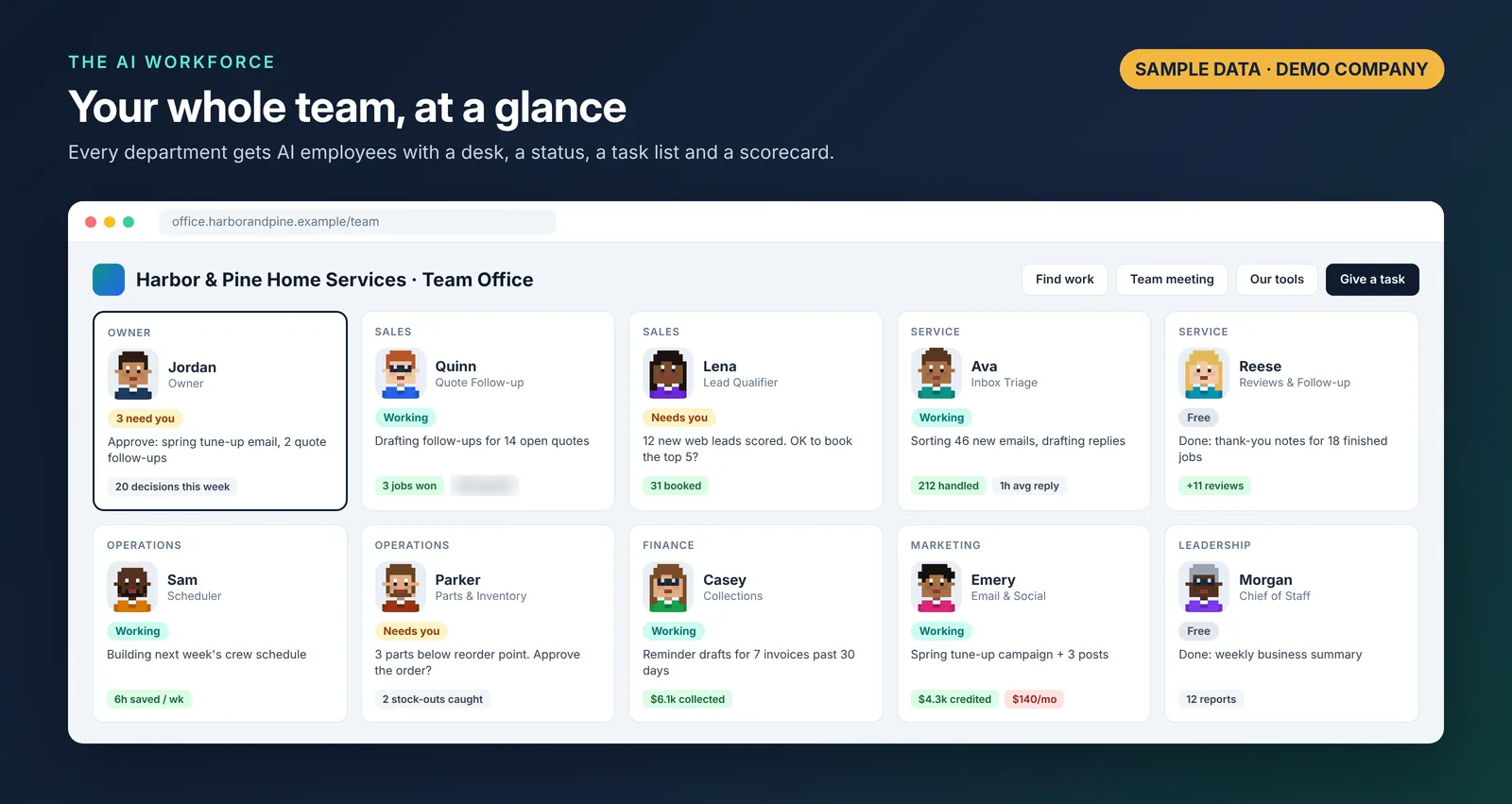
Each AI employee owns one area. Its desk shows whether it's Working, needs you, or is Free, along with its tasks, chat, files, and finished work.
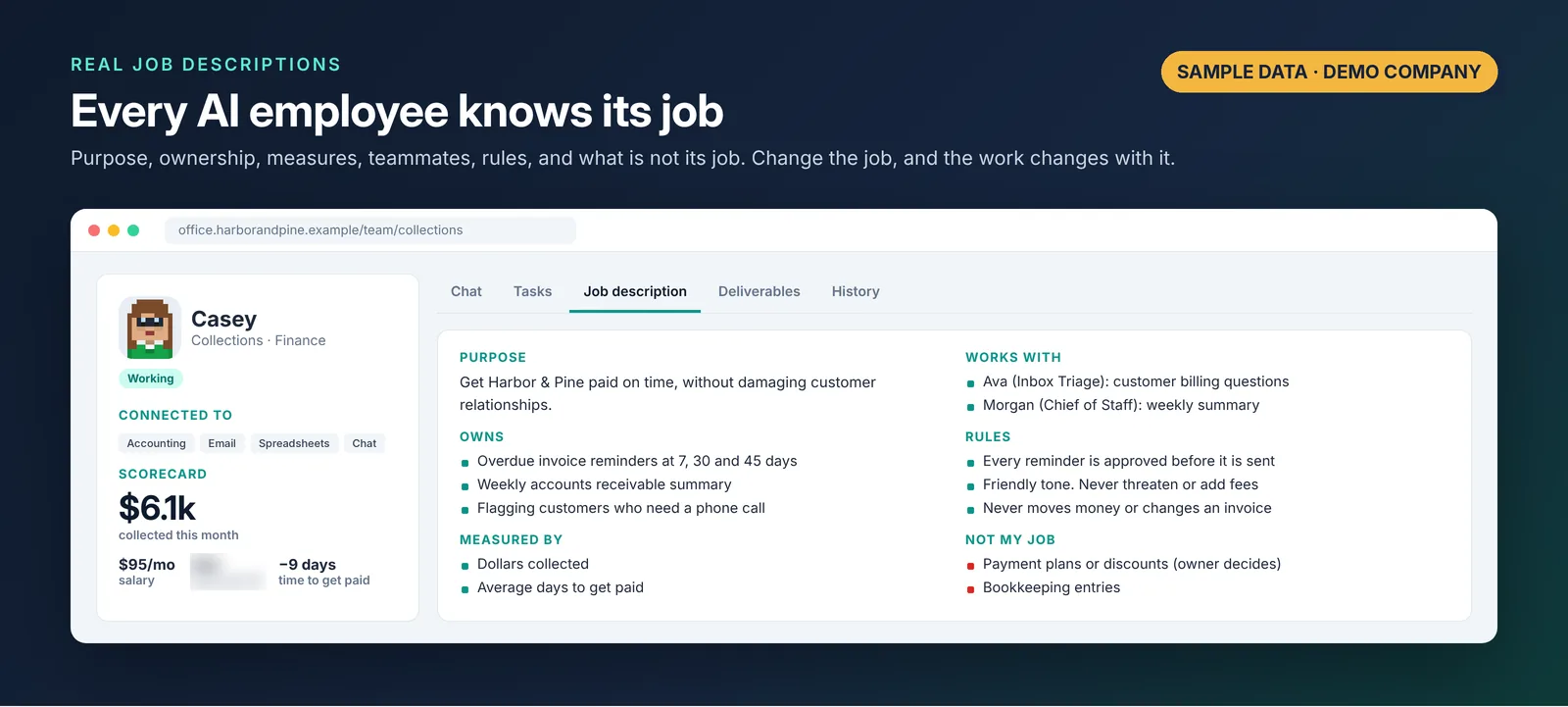
A real job description
A purpose, what it owns, how it's measured, what is not its job, and the rules it must follow. Change the job description and you change how it works.
Connected to your tools
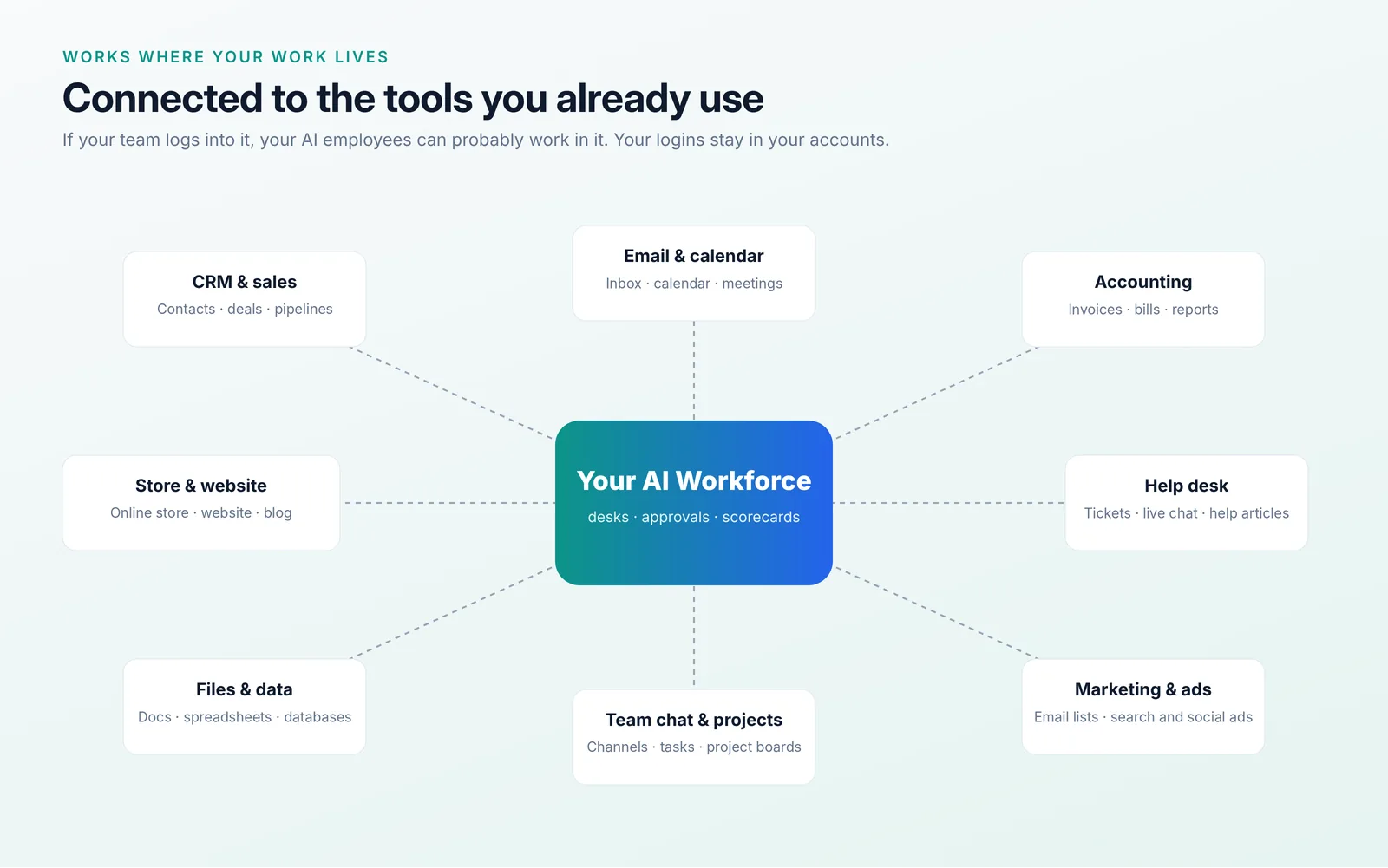
Each desk works inside the systems its job needs: your store, CRM, inbox, calendar, accounting, spreadsheets, help desk, website, or team chat.
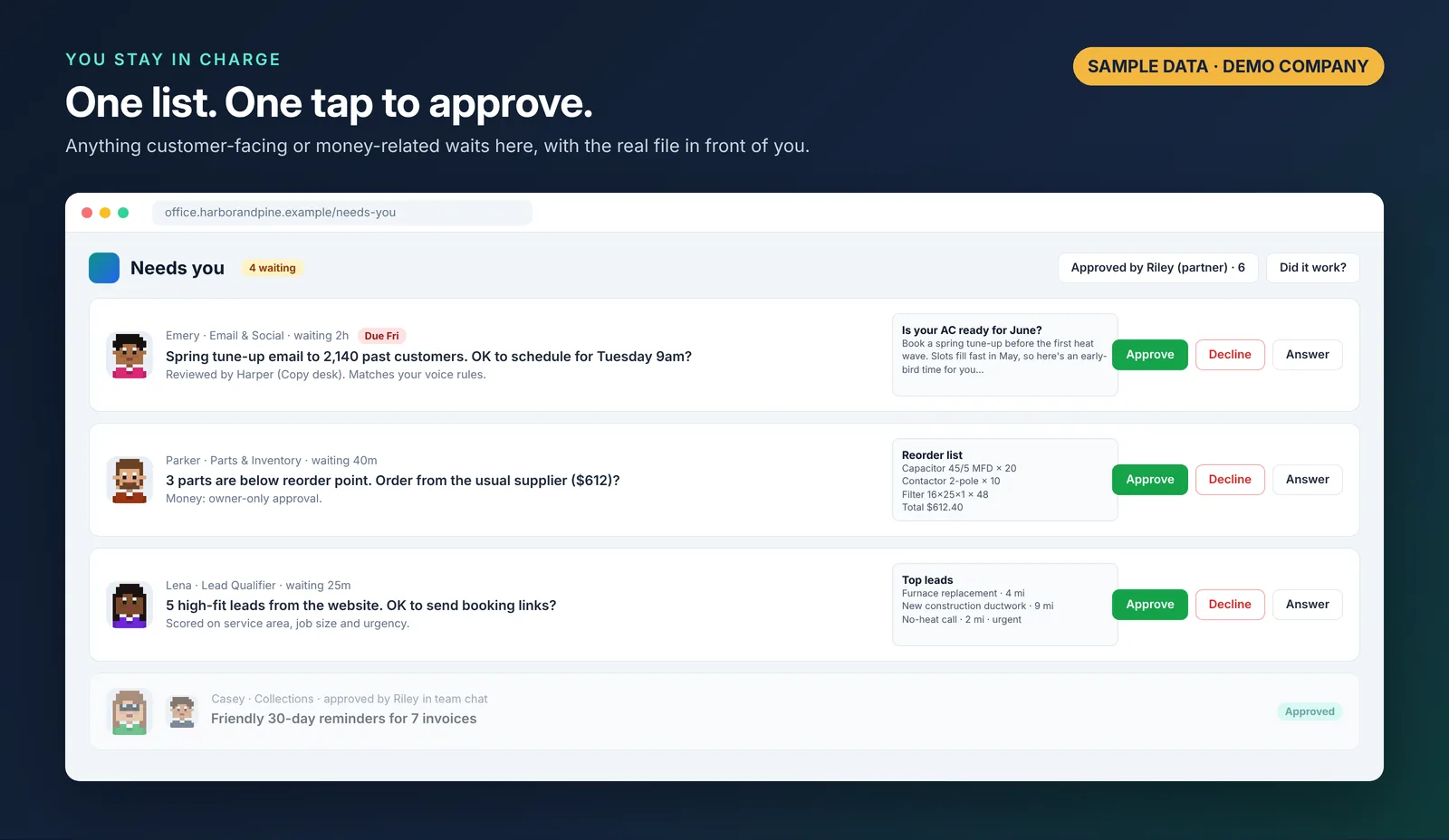
One "Needs you" list
Everything waiting on you, in one place, with the real file shown, how long it has waited, and when it's due. Approve or decline with one tap.
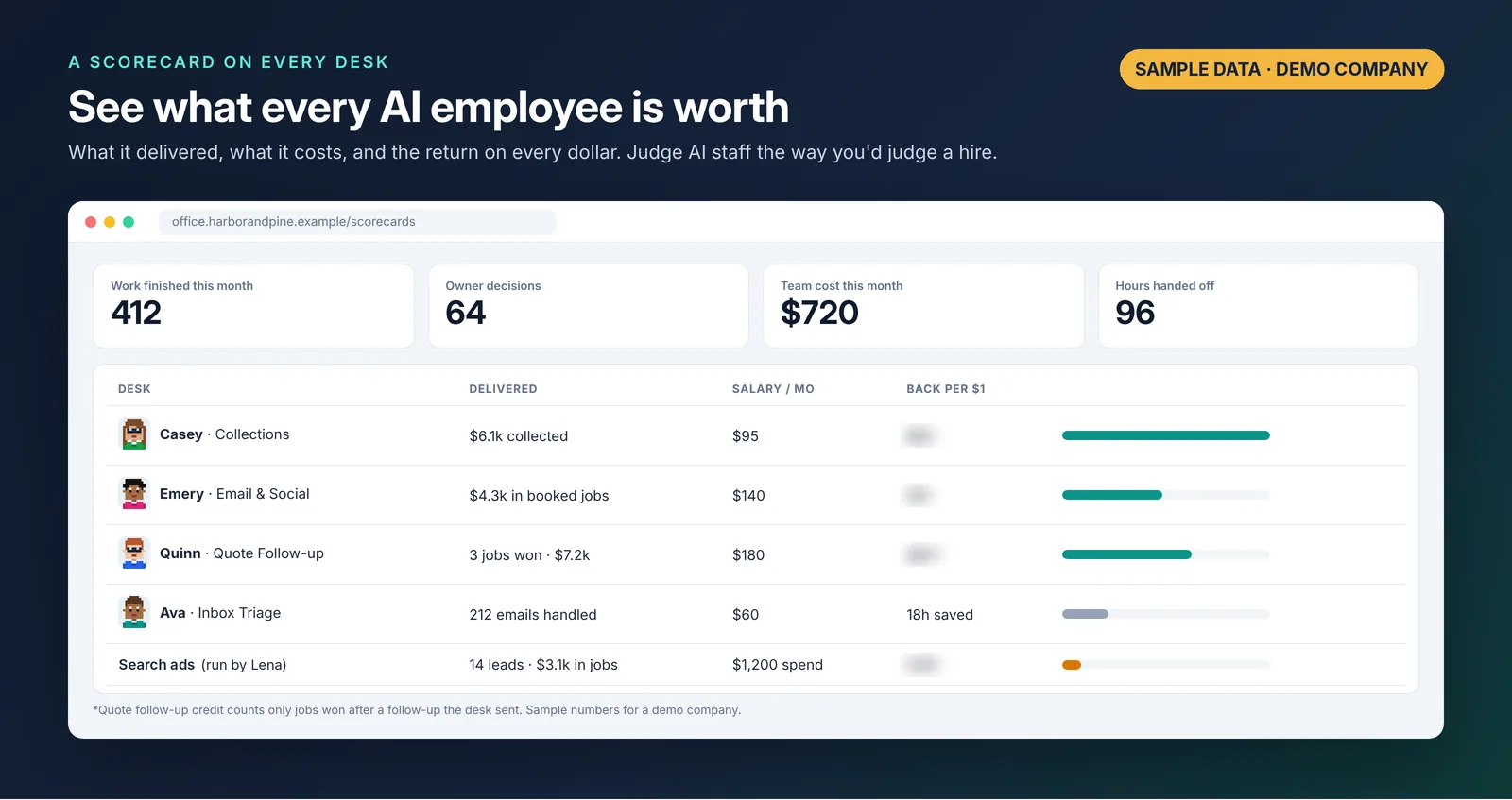
A scorecard on every desk
What it delivered, like sales, leads booked, tickets closed, invoices collected, or hours saved, next to its "salary" and its return for every $1.
A team you manage
Hire a desk when a need appears, retire one that isn't earning its keep, and let a partner or manager approve the work you've handed them.
How it works
You hand out work. You make the calls.
Your day becomes a short list of approvals instead of a long list of tasks.
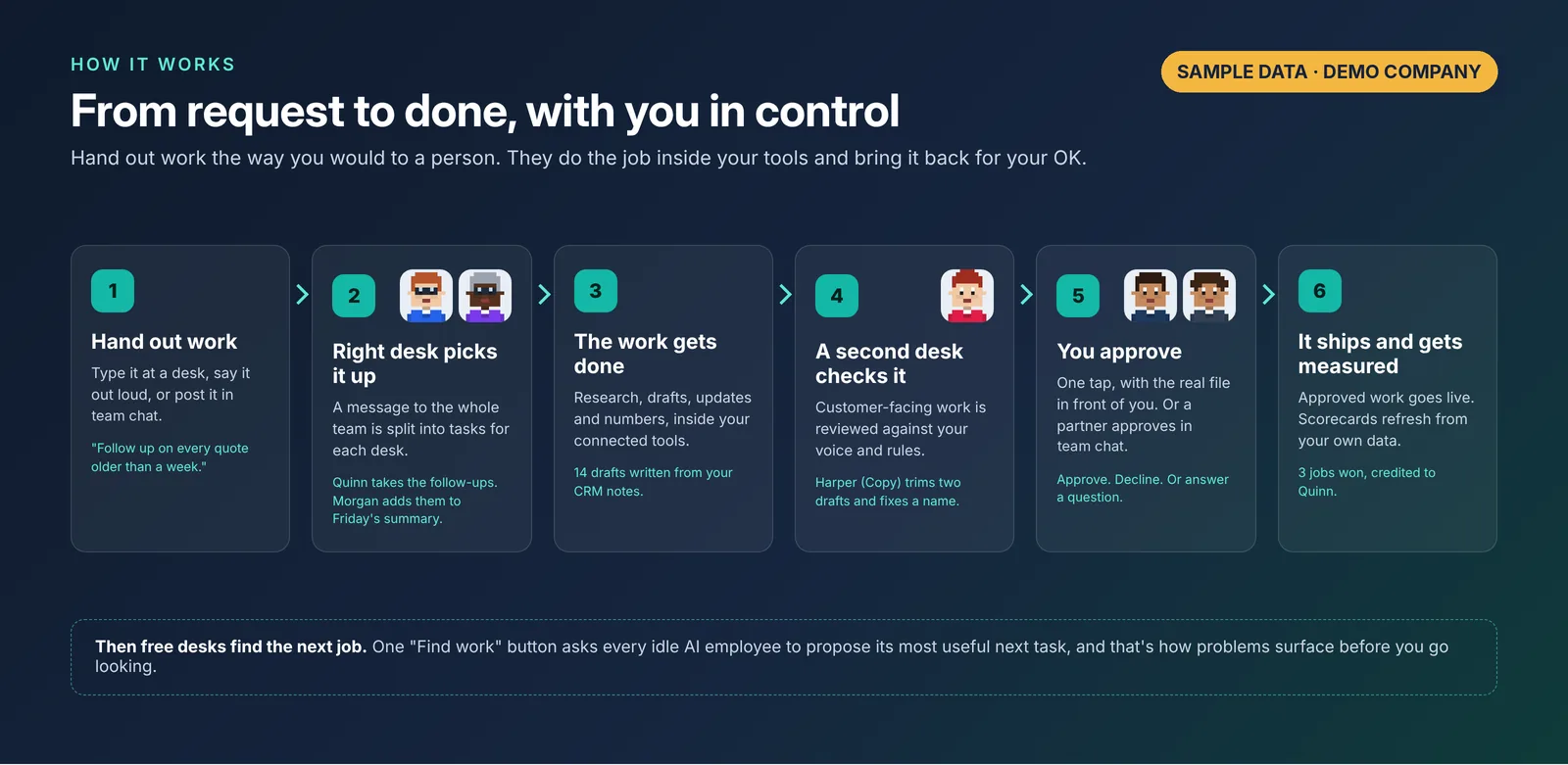
You hand out work
Type it at a desk, say it out loud, or post it in your team chat. A message to the whole team gets split into tasks for each desk that should act on it.
The desk does the work
It does the research, writes the draft, updates the system, or runs the numbers, inside the tools you already use.
A second desk checks it
A review desk checks customer-facing work against your voice and your rules before you ever see it.
You decide
Finished work lands on your Needs-you list. One tap approves or declines, and every approval is logged.
It ships and gets measured
Approved work goes live, and scorecards refresh several times a day from your own data.
Free desks find work
One "Find work" button asks every idle desk to propose the most useful next job in its area. This is where desks catch problems nobody asked them to look for.
Connected to your tools
Works where your work already lives
If your team logs into it, your AI employees can probably work in it. We connect each desk to what its job needs during setup, and your logins stay in your own accounts.
Any department, any business
Sample desks by department
We design the desks around your departments. Start with one and add more. These are examples, not a fixed menu: desks are hired and retired as your needs change.
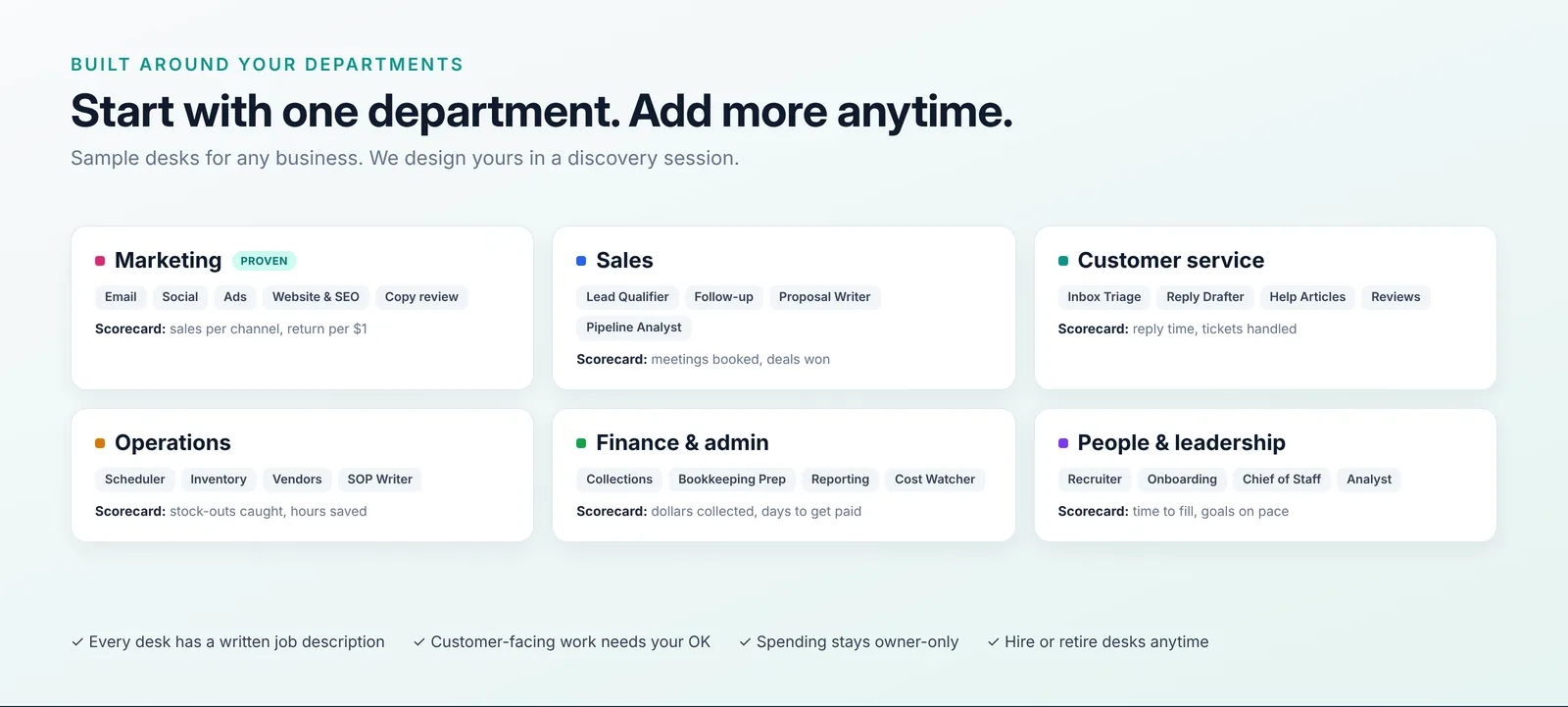
Marketing
Email, Social, Ads, Website and SEO, Copywriter, and Creative desks
Campaigns, posts, ad reviews, pages, blogs, and creative.
Scorecard: sales per channel and return per $1
Sales
Lead Qualifier, Follow-up Manager, and Proposal Writer desks
Research leads, draft follow-ups, build proposals, and flag stalled deals.
Scorecard: meetings booked and deals won
Customer service
Inbox Triage, Reply Drafter, and Knowledge Base Writer desks
Sort tickets, draft replies, and turn repeat questions into help articles.
Scorecard: reply time and tickets handled
Operations
Process Manager, Inventory Watcher, and Scheduler desks
Write SOPs, send stock alerts, follow up with vendors, and build schedules.
Scorecard: stock-outs caught and hours saved
Finance and admin
Bookkeeping Prep, Collections, and Reporting desks
Categorize transactions for review, send late-invoice reminders, and build monthly reports.
Scorecard: dollars collected and days to get paid
HR and recruiting
Recruiter and Onboarding Coordinator desks
Write job posts, screen applications for a person to decide on, and run onboarding checklists.
Scorecard: time to fill
Leadership
Chief of Staff, Analyst, and General Manager desks write the weekly business summary, track pacing against your goals, do research, and suggest changes to the office itself. Scorecard: goals on pace.
The same three benefits in every department
| Department | See what's going on | Get more done | Add to the bottom line |
|---|---|---|---|
| Marketing Proven | Return per $1 for every channel | About 33 finished deliverables a day | Sales up alongside the team, wasted spend cut |
| Sales | Which leads and sources close | Follow-ups, quotes, and CRM updates done daily | More deals closed per rep |
| Operations | Stock, delays, and bottlenecks flagged early | Schedules, orders, and reports handled | Fewer stock-outs and rush costs |
| Customer service | Why customers write in and why they leave | Replies drafted and reviews requested | Better retention |
| Finance | Profit per product, job, or client | Invoices, reconciliations, and reports | Margin visible and protected |
Marketing shows real results from the first build. The other rows describe what's possible, not results.
Approvals and guardrails
"Will it do things I didn't OK?" No.
It's the first question every owner asks, so these rules are built in from day one.
- Nothing customer-facing goes out without approval. Emails, social posts, ads, promotions, and public website copy all wait for your yes.
- Ad spend is owner-only. No desk changes a budget, and only the named owner can approve a spend change.
- Only named people can approve. A casual "sounds cool" is treated as input. Only a clear yes to a clear ask counts.
- Delegated authority is explicit. You can let a partner or manager approve certain work, and everything they approve is listed for you to review.
- Backups before every change. Every page or site edit is backed up first, so anything can be rolled back.
- Your business rules are written into each desk. For example: never link to competitors, never invent reviews or customer quotes, and check what's already scheduled before planning more.
- Decisions stick. When you decline something or delete a plan, it stays gone. Desks don't quietly bring it back.
- People decisions stay human. Hiring, firing, medical, legal, and financial calls are made by people.
- Private data stays private. Scorecards show order numbers and totals, never customer names, emails, or addresses. Logins stay in your own accounts.
A scorecard on every desk
Judge AI staff the way you'd judge a hire
Every desk shows what it delivered, what it costs each month, and what comes back for every $1. Scorecards refresh several times a day from your own data, so you can see which desks earn their keep.
New: the Business Dashboard
Your plans and your numbers, on one live page
Most owners keep their plans in one place and their numbers in five others, so it's hard to tell what's working. The Business Dashboard pulls your tools into one live page and shows whatever you need to keep track of: a marketing calendar, a sales pipeline, jobs and schedules, inventory, cash, or progress toward your goals. AI keeps it up to date for you. Start with it on its own, or add it to any AI Workforce package.
Here's what it looks like for a marketing plan, where we built it first:
Sales this month vs last year
+12%
Gap to yearly goal
$18,400
Orders today
37
Waiting on you
3
This week's plan
- Mon Holiday gift email Scheduled
- Tue Gift guide blog post Needs you
- Wed New shipping-cutoff banner Scheduled
- Thu Customer photo post Cancelled
- Fri Weekend sale email Drafting
What each source brings back per $1
- Website and search$9.10
- Email$7.40
- Ads$3.20
- Social$2.10
Sample data from a demo company, not client results.
One calendar for the whole plan
Every campaign, job, task, or deadline sits on one calendar. When something is planned, changed, or cancelled, the plan updates on its own.
Numbers that stay current
The numbers you care about, like sales against last year, the gap to your yearly goal, open jobs, stock levels, or cash on hand, refreshed several times a day.
See what's working
Your data from different tools, side by side. For marketing, that means visits and sales from email, ads, social, search, and your website, so you can see what each source returns for every $1.
Ask about anything, in plain words
Every item has a button to ask the AI to check it. Another button lets you change the plan by just typing what you want, like "move the sale email to Friday" or "add a follow-up for every quote over $5,000."
See your AI team at work
An office view shows each AI team member's tasks, finished work, and anything waiting on your approval.
Nothing changes without you
The same rules as the rest of the AI Workforce: nothing goes out to customers, and no money is spent, without your yes.
What it showed a DTC beverage brand. With the dashboard in front of them, the owners went from not knowing where more than a quarter of their sales came from to tracing 80% of them to a known source (up from 72%). They could see that email brings back $14 for every $1 and their website and search bring back $22, so they moved money away from what wasn't paying off.
One price, with or without an AI team
A low-cost first step, or an add-on to any plan
- On its own: start with the dashboard for whatever you need to track. We set it up, connect your tools, and train you on it.
- With your AI Workforce: add it to Starter, Team, or Office, and the plan, the numbers, and the work your AI employees are doing all sit in one place.
$1,500 setup
then $150/month, 3-month minimum
What setup involves
Up and running in about four weeks
We build it, connect it, and tune it with you.
Discovery and connections
A working session on your goals, departments, tools, and the jobs that eat your time. We connect the tools the desks will use and agree on who approves what.
Build the office
We set up each desk with a name, job description, tools, and rules, plus scorecards that show each desk's results and monthly cost.
Pilot
Desks get real tasks. You approve, decline, and give feedback while we tune the rules. You finish with a before-and-after report.
Your monthly plan
Run it yourself with us fixing and updating it, or have us manage it and set the strategy to keep improving it.
Pricing
Start with one area, grow from there
One setup fee to build your team, then a monthly Care plan that scales with it.
Founding offer: our first 5 AI Workforce clients get 25% off setup in exchange for letting us share their results (anonymously, if you prefer).
1. One-time setup
Includes building the office, training for you and your team, and 30 days of support.
Starter
One area, 2 to 3 AI team members
The quickest way to see AI employees working in one part of your business.
$2,500
$1,875 with the founding offer
Team
A full department
A complete team for one department, so more of its work runs in parallel.
$5,000
$3,750 with the founding offer
Office
Several departments
Desks across your business, all managed from one office and one Needs-you list.
from $10,000
from $7,500 with the founding offer
2. Monthly Care, starting after the first 30 days
Care keeps your team running and improving: monitoring, fixes, updates as your tools change, and a monthly review of what to improve next. It scales with your plan and has a 3-month minimum.
Starter Care
For one area
Your 2 to 3 AI team members kept working, updated, and tuned each month.
$500/month
Team Care
For a full department
The whole department's team kept working and improving, with new desks added as your needs change.
$1,000/month
Office Care
For several departments
Every department's team kept working and improving, with fixes within one business day.
from $2,000/month
Add-on: the Business Dashboard puts your plans and your numbers on one live page, for $1,500 setup and $150 a month (3-month minimum).
Your tools, your accounts: you pay your own AI and software plans directly, so you always own your accounts and your data.
Case study: proven first in marketing
A DTC beverage brand's first five days with an AI workforce
A small direct-to-consumer beverage company with three product lines, two websites, an email list of about 5,000, paid ads, and daily social posts. Two co-owners ran it with no marketing staff. One owner handled all the marketing, spend was judged by feel, and about a third of orders couldn't be traced to any channel.
We built a marketing office of 13 AI desks plus two owner desks, covering email, social, ads, website and SEO, creative, copywriting, a lead for each product line, retention, attribution, and a general manager. We connected 16 of the business's systems, and the co-owner sends ideas and approves work from a private team chat channel.
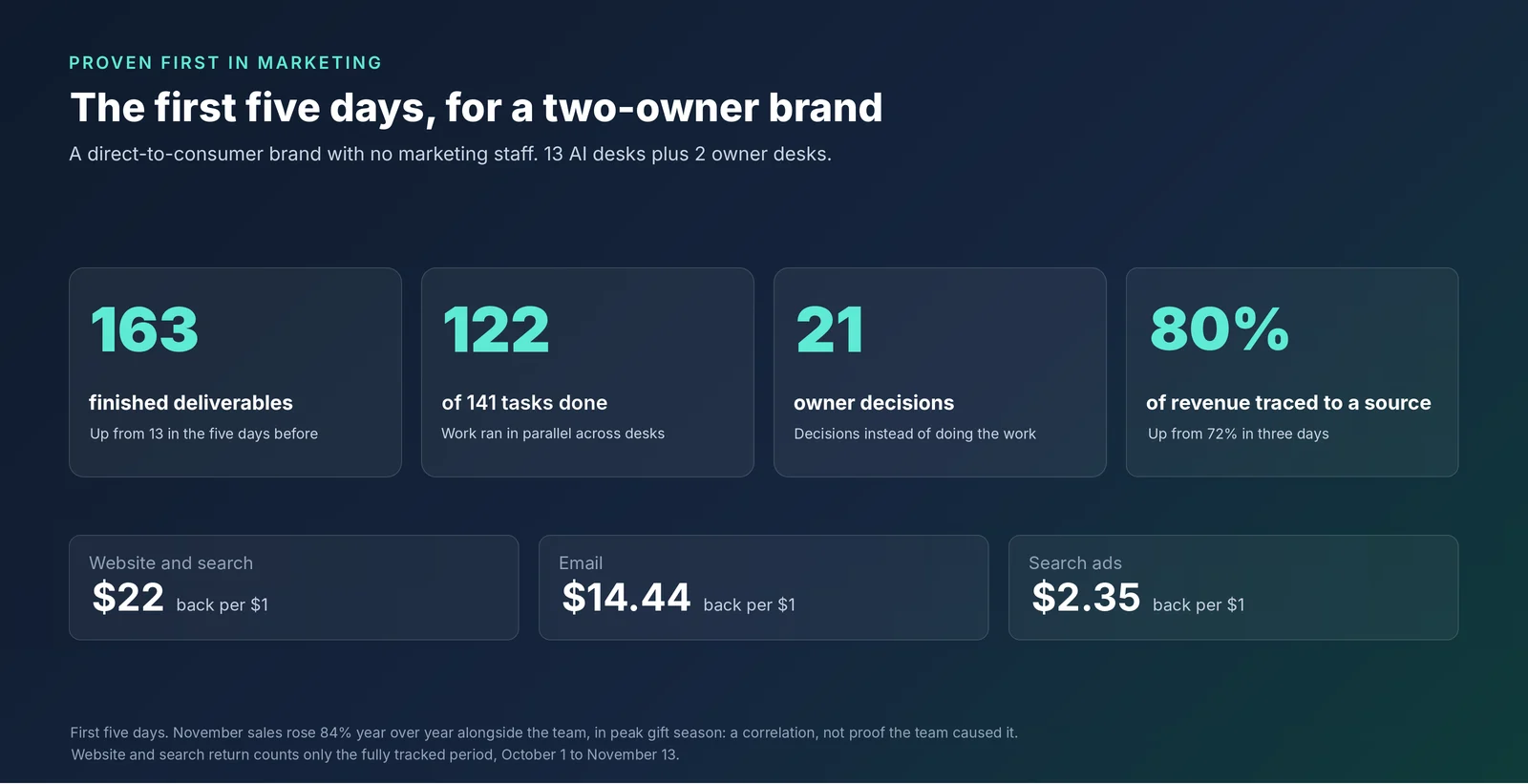
The results line up with the three things an AI workforce is for: seeing what's really going on, getting more done, and adding to the bottom line.
1
See what's really going on
The owners went from running marketing by feel to knowing where sales come from and what was holding them back.
of revenue now traced to a known source
revenue with an unknown source, cut in three days while sales kept coming in
named causes behind the "unknown source" pile, each with a fix
- What each product really earns: profit per unit for every product line, so effort goes where the margin is.
- The weekly shop email had no tracking tags, so its sales were showing up as "unknown."
- Holiday timing: almost 90% of last year's gift orders came in December, so gift ads and emails now run through December 24.
- Search ads were mostly paying for clicks on the brand's own name, so that budget moved to shopping ads that sold the gift product at a strong return.
- Social ads were optimizing for add-to-carts instead of sales, hidden checkout errors were found on both stores, and email opens were sliding, so new emails are now checked against what's already scheduled.
For any business: a clear, current picture of what's working, what isn't, and why, without hiring an analyst.
2
Get more done
The owner went from doing all the marketing to making decisions on finished work.
finished deliverables in five days, up from 13 in the five days before
desk tasks done
owner decisions instead of owner work
of the business's systems connected
- About 33 finished deliverables a day, worked on in parallel across 13 AI employees.
- Planned work went from 5 items a week to 50.
- 10 new or rebuilt website pages and features went live in one week, including a new homepage, a reviews page, and a gift receipt card.
- A seven-email welcome series was built and switched on in a day.
- A partner post every day for 15 days across three social networks.
- An 800-product catalog, each item with a real photo.
The owners made 21 decisions in five days (17 approved, 3 declined, and 1 answered) instead of doing the work themselves. Nothing went live, and no money was spent, without an owner's OK. The team changed too: three new desks were hired and one was retired in the first week.
For any business: your team's capacity multiplies without new hires, and your people spend their time on decisions, not busywork.
3
Add to the bottom line
Every channel now shows its cost next to the sales it can be credited with, so money goes where it returns the most.
back for every $1 on the brand's own website and search, the best of any channel
November sales compared with last November, alongside the team's launch (peak gift season)
from links on the brand's own site and blog in 13 days, a brand-new channel
- The year-to-date gap to last year shrank by two-thirds in five days, from 5.0% behind to 1.8% behind.
- Gift product sales rose 18% in units and 27% in revenue against the same dates last year.
- Sales from search and the brand's own site roughly tripled, from about $1,000 a week in October to $3,158 in the week of November 2.
- Spend works harder: ad money moved off clicks on the brand's own name toward the ads that produce orders, and social ads now optimize for purchases.
| Channel | Back per $1 | What changed |
|---|---|---|
| Website and search | $22 | The best return of any channel, counting only the fully tracked period (October 1 to November 13) against hosting, domains, and website tools. |
| $14.44 | Confirmed as a top channel. The desk also caught falling open rates, so new emails are checked against what's already scheduled. | |
| Search ads | $2.35 | Budget moved off clicks on the brand's own name and onto shopping ads for the gift product. |
The honest caveats. These numbers come from the team's first five days. The sales lift, including the jump in website and search sales, happened alongside the team, in peak gift season, so we treat it as a correlation, not proof the team caused it. The output, the clearer picture, and the decisions it led to are direct results. Year-to-date channel credit from before the store's order tracking started is an estimate built from analytics.
What you can expect
More output without more hires
Work runs in parallel across departments instead of waiting in one person's queue.
Time moves from doing to deciding
Your day becomes a short list of approvals, not a long list of tasks.
You see what everything is worth
Every desk carries its cost and return, so spend decisions rest on numbers, not feel.
Problems surface early
Idle desks go looking for the next useful job, which is how stock-outs, tracking gaps, and wasted spend get caught.
You stay in control
Approvals, owner-only spend, backups, and written rules mean nothing important happens without you.
It grows with you
Add a desk when a new need appears, and retire one when it doesn't earn its keep.
FAQ
AI Workforce questions
What is an AI workforce?
An AI workforce is a team of AI employees, each with one job. At KeyProcess Automation Services, every AI employee has a desk, a name, a written job description, a task list, connections to the tools its job needs, and a scorecard that shows what it delivered and what it cost. You hand out work the way you would to a person, and you approve anything that matters.
Will the AI employees do things I didn't approve?
No. Nothing customer-facing goes out and no money is spent without a clear yes from a named person. Ad spend is owner-only, every change is backed up first, and when you decline something it stays declined.
Which departments can have an AI workforce?
Any department with repeatable work: sales, customer service, operations, finance and admin, HR and recruiting, marketing, and leadership. It was proven first in marketing, and the same desks, approvals, and scorecards fit every other department.
What tools can the AI employees work in?
If your team logs into it, your AI employees can probably work in it: your CRM, inbox, calendar, files, spreadsheets, accounting, online store, help desk, project boards, team chat, website, and ad accounts. Your logins stay in your own accounts.
How long does it take to set up?
About four weeks. Week 1 is discovery and connecting your tools, week 2 is building the office, and weeks 3 and 4 are a pilot that ends with a before-and-after report. After that, a monthly plan keeps the workforce running and improving.
Does an AI workforce replace my staff?
It takes repeatable work off your team so people spend their time deciding instead of doing. Hiring, firing, medical, legal, and financial decisions always stay with people.
What is the Business Dashboard?
It's one live page that pulls in data from the tools you already use and shows whatever you need to keep track of: a marketing calendar, a sales pipeline, jobs and schedules, inventory, cash, or progress toward your goals. AI keeps it up to date several times a day, and you can ask it to check anything or change the plan in plain words. It's an add-on: $1,500 setup and $150 a month, with a 3-month minimum. You can start with it on its own or add it to any AI Workforce package.
How much does the AI Workforce cost?
Setup is a one-time fee: Starter (one area, 2 to 3 AI team members) is $2,500, Team (a full department) is $5,000, and Office (several departments) starts at $10,000. Setup includes training and 30 days of support. After that, a monthly Care plan keeps it running and improving, with a 3-month minimum. Care scales with your plan: $500 a month for Starter, $1,000 for Team, and from $2,000 for Office. You pay your own AI and software plans directly. Our first 5 clients get 25% off setup in exchange for sharing their results.
See the office working
Book a free one-hour walkthrough. We'll show the office running on a demo company: give a desk a task, watch it get picked up, approve it, and see it go live. Then we'll sketch which desks your departments would get first.
Book a walkthroughOr email tyler@keyprocessautomation.com