 KeyProcess Automation Services
Blog · Industry playbooks
Property management automation: what to automate, what it costs, and real results
A plain-English guide for property managers: where automation saves the most time in leasing, maintenance, accounting, marketing, and compliance, what should stay personal, what it costs, and how to start without switching software.
The short answer: property management automation means letting the repetitive parts of running rentals, like lease paperwork, work order follow-ups, payment checks, listing updates, and reports, happen on their own. Your team handles only the exceptions. Most firms can automate around the software they already use, and the biggest wins usually come from leasing and maintenance.
Key takeaways
- The best tasks to automate repeat every week, follow the same rules, and cost money or goodwill when they slip.
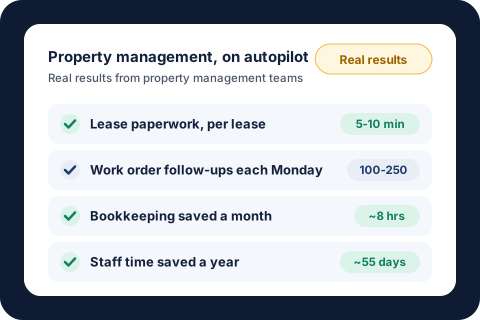
- Leasing paperwork and maintenance follow-ups are usually the biggest time savers. In our work, lease paperwork dropped from up to 2 hours to 5 to 10 minutes per lease.
- You rarely need new property management software. Automation can work around the system you already have.
- Keep tenant conflicts, owner relationships, and judgment calls with people.
- A single automated process starts at $1,000, and a good first project pays for itself in months.
What is property management automation?
Property management automation is setting up the routine work of managing rentals so it runs on its own, on schedule and by the same rules every time, instead of waiting for someone to remember it.
Think of the work that fills a property manager's week: building approval letters and leases, chasing vendors on open work orders, checking utility bills, updating listings when a unit rents or the price drops, pulling the weekly report, and checking that licenses are current. None of it is hard. It's just constant, and it all depends on someone remembering to do it.
Automation takes the remembering out of it. The paperwork builds itself from details you already have. Reminders and follow-ups go out on the right day. Reports show up in your inbox. And your team gets a short list of only the things that need a person.
It's different from buying property management software. Your software is where the information lives. Automation is what moves that information around, fills in the documents, and sends the follow-ups, so people don't have to.
Why automate property management work?
Because most of a property manager's day is administration that follows the same steps every time, and every hour of it costs real money.
Property, real estate, and community association managers held about 460,400 jobs in 2025, according to the Bureau of Labor Statistics. The BLS describes their duties as including collecting monthly fees from tenants, arranging repairs, keeping records of rental activity and owner requests, and preparing budgets and financial reports. A lot of that is exactly the kind of work automation handles well.
Their time isn't cheap. The median pay for these managers was $33.65 an hour in May 2025, per the same BLS page. Benefits added about 30% to private employers' compensation costs in June 2026, according to the BLS. So an hour of a property manager's time really costs you about $48. Even the admin staff who support them cost about $31 an hour once benefits are counted, based on the $21.64 median hourly pay for general office clerks in May 2025.
The other reason is consistency. When follow-ups depend on memory, the busy weeks are exactly when things slip: a vendor isn't chased, a price drop isn't posted, a license lapses. Automation does the routine work the same way in a slow week and a slammed one.
What can you automate in property management?
Almost any task that repeats and follows rules. Here's where we see the biggest wins, area by area, with real results from our own work. For a longer checklist, see our list of 25 property management tasks you can automate.
Leasing
Approval letters, payment summaries, ready-to-sign leases, and the end-of-day approvals report can all build themselves from the details already in your system. For one property management team, the paperwork for each lease dropped from 1.5 to 2 hours to 5 to 10 minutes, across 300 to 400 leases a year. That's about 55 workdays of staff time saved every year. See the lease approval case study and our leasing automation page.
Maintenance
Stalled work orders are one of the most common sources of tenant complaints. Every vendor with a work order open two weeks or more can get a personal status request automatically, with replies coming straight back to your team. For one team that's 100 to 250 follow-ups every Monday, 100% of stalled work orders chased, and about 8 hours saved a month. See the work order case study and our maintenance automation page.
Accounting and bookkeeping
Recurring bills and payments can be matched to the right property and logged automatically, with one daily email flagging only what needs a closer look. One team's water bills are now reconciled every day with zero data entry, saving about 8 hours of bookkeeping a month. See the water bill case study and our property management bookkeeping automation page. Tenant and owner payment reminders work the same way; our guide to automated payment reminders has a schedule and wording you can use.
Marketing and leasing up
Vacancies cost money every day, so listings need to stay current everywhere. In one of our projects, the whole portfolio is checked every night. New rentals are posted with their descriptions and photos, and price drops and rented units are updated on 3 platforms. Each team also gets a to-do list at 9 AM. See the rental listings case study.
Knowing which listing sites actually bring tours matters just as much. Every Monday, one team gets a report matching last week's showings to their source, with which sites turn into leases and which lead to cancellations (showing sources case study). And to win new doors, rental owners in target ZIP codes can be found on the 1st of each month, with a postcard campaign ready for one-click approval (owner prospecting case study). Our rental marketing automation page has more.
Compliance and operations
Licenses, certificates, and inspections are easy to lose track of across a portfolio. For one Philadelphia team, every property's rental license and certificate is checked monthly, with zero lookups by hand and an instant alert when something fails (compliance case study). The same idea works for insurance certificates, vendor documents, and any deadline that has to stay current.
Do you need new software to automate property management?
Usually not. Most property managers already have software that holds their leases, tenants, work orders, and accounting. The problem isn't missing software. It's the manual work that happens around it: copying details into letters, chasing people, building reports, and checking one system against another.
We build automations around the tools you already use, so your team doesn't have to learn a new system or move your data. You keep your accounts and your data, and the work that used to happen by hand just happens. If someone recommends switching your whole platform as the first step, ask what it would save compared with automating around what you have.
What should stay personal in property management?
Anything that needs judgment, empathy, or a relationship. In our view, property managers get the most from automation when they're clear about where it stops.
- Tenant conflicts and hardship conversations. A tenant who's struggling to pay or upset about a repair needs a person, not a template.
- Owner relationships. Reports can build themselves, but the owner call about a big repair or a vacancy should come from you.
- Approvals that carry risk. Automation can prepare an approval packet in minutes, but a person should still make the decision.
- Anything legal. Notices with legal weight, disputes, and anything heading toward eviction should be handled by people and checked against your local rules.
The goal isn't to take people out of property management. It's to stop spending their time on copying, chasing, and checking, so they have more of it for tenants and owners.
What does property management automation cost?
With KeyProcess Automation Services, a single automated process starts at $1,000, and a package of 3 to 5 connected automations starts at $3,000. Automation Care, which keeps everything monitored, fixed, and improved, starts at $500 a month. Every project starts with a free audit and a fixed quote, so you know the price before any work begins. Our guide to what business automation costs explains what moves those numbers.
Here's how that compares with what it saves, using the lease approval result above. About 55 workdays a year is roughly 440 hours. At the $31 an hour an admin really costs, that's about $13,640 a year in staff time, from one process. Even at a fraction of that, a $1,000 project pays for itself in months, not years. Our guide to calculating automation ROI walks through the method, and the savings calculator runs it with your own numbers.
If an automation doesn't save your team time in the first 30 days, we fix it free until it does.
How do you get started with property management automation?
Start with one process, not your whole operation. Here's the order we recommend:
- List the repetitive work. Ask your team to jot down every task they repeat weekly or more for one normal week, with how long it takes.
- Score each task. How often does it happen, how long does it take, does it follow the same steps every time, and what does a miss cost? Our automation audit guide has a simple scorecard.
- Pick the one with the clearest win. For most property managers that's lease paperwork, work order follow-ups, or keeping listings current.
- Decide where a person stays involved. Approvals, owner calls, and tenant conversations stay human.
- Measure it. Compare the hours before and after in the first month. Then pick the next process.
Most firms that start this way find the second and third automations come faster, because the team can see the first one working. Whether you manage 50 units or 5,000, the starting point is the same: the task your team complains about most.
About the author. Tyler founded KeyProcess Automation Services and has built dozens of automations, small and large, for property management and e-commerce teams. You can see what they changed on our results page.
FAQ
Common questions about property management automation
What is property management automation?
Property management automation is setting up the routine work of managing rentals, such as lease paperwork, work order follow-ups, payment checks, listing updates, and reports, so it runs on its own on a schedule. Your team only handles the exceptions that need a person.
What property management tasks can be automated?
Most tasks that repeat and follow rules: approval letters and leases, vendor follow-ups on open work orders, bill and payment checks, listing updates when a unit rents or the price drops, weekly reports, and license and certificate checks. Our list of 25 property management tasks covers more.
Do I need new property management software to automate?
Usually not. Most firms already have software that holds their leases, tenants, and accounting. Automation can work around the system you already use, so your team doesn't have to learn a new platform or move data.
How much does property management automation cost?
With KeyProcess Automation Services, a single automated process starts at $1,000, a package of 3 to 5 connected automations starts at $3,000, and Automation Care starts at $500 a month. Every project starts with a free audit and a fixed quote.
Will automation replace my property management staff?
No. It takes over copying, chasing, and checking, so your team spends more time on tenants, owners, and decisions. Tenant conflicts, owner relationships, approvals, and anything legal should stay with people.
What should a property manager automate first?
Start with the task your team complains about most that repeats every week and follows the same steps. For most property managers that's lease paperwork, work order follow-ups, or keeping listings current, because they save the most hours and slip most often in busy weeks.
Find out what your team could stop doing by hand
Book a free 30-minute audit. We'll look at your leasing, maintenance, accounting, and marketing work, and you'll leave with a written list of what to automate first and what it could save you, whether you hire us or not. We're taking only 3 new clients this quarter.
Request your free auditOr email tyler@keyprocessautomation.com